
Major County Court Records After a Jail Arrest
After an arrest in Major County, the first public record many people see is the Major County Jail roster. That roster is operated by the Major County Sheriff's Office and is used for current local custody at the Major County Jail in Fairview. It can show a booking date, a jail profile, roster charge text, and whether the person appears to be in current custody. It is not the same thing as the district court case.
Formal court records after an arrest come from Major County District Court after prosecutor review. The District 26 District Attorney decides what to file after reviewing law-enforcement reports and evidence. The prosecutor may file a complaint, information, indictment, application to revoke, or another charging document. The court case can add, amend, reduce, dismiss, or decline charges that looked different at booking. For custody details, use jail inmate records. For booking photos, use jail mugshots. For filed charges, use ODCR, OSCN, or the Major County Court Clerk.
How to Find Major County Court Records After an Arrest
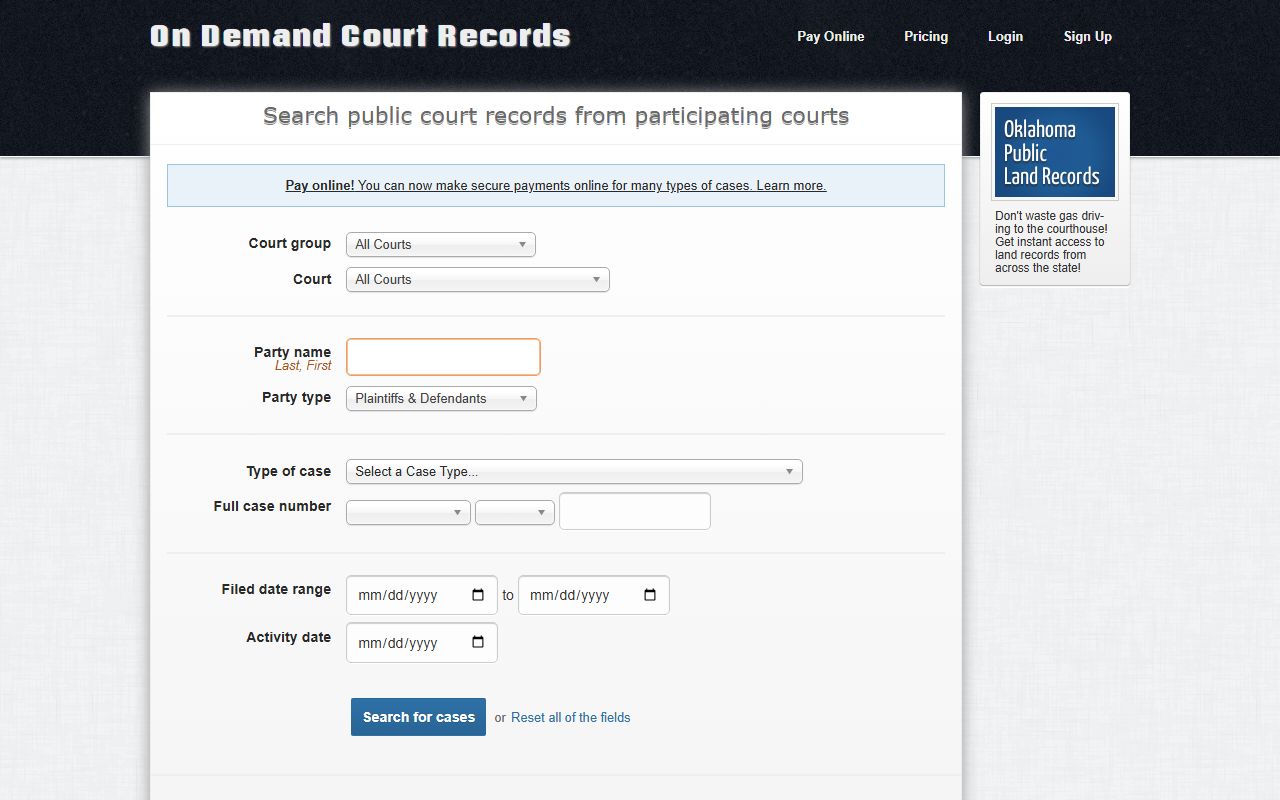
Major County criminal cases are handled in Major County District Court. The official county court clerk page states that the clerk maintains the records, files, and proceedings of District Court. Online searches are usually done through ODCR or OSCN docket search. ODCR lists Major OK as a participating court, identifies Court Official Lindsey Keck, gives the court phone as (580) 227-4690, and reports hourly updates from a data start date of October 30, 1997.
- Start with the Major County jail roster to confirm the name spelling, booking date, and any visible case-number text.
- Search ODCR by defendant name, partial name, or case number. Narrow the court group to Oklahoma District Courts or Major OK when the option is available.
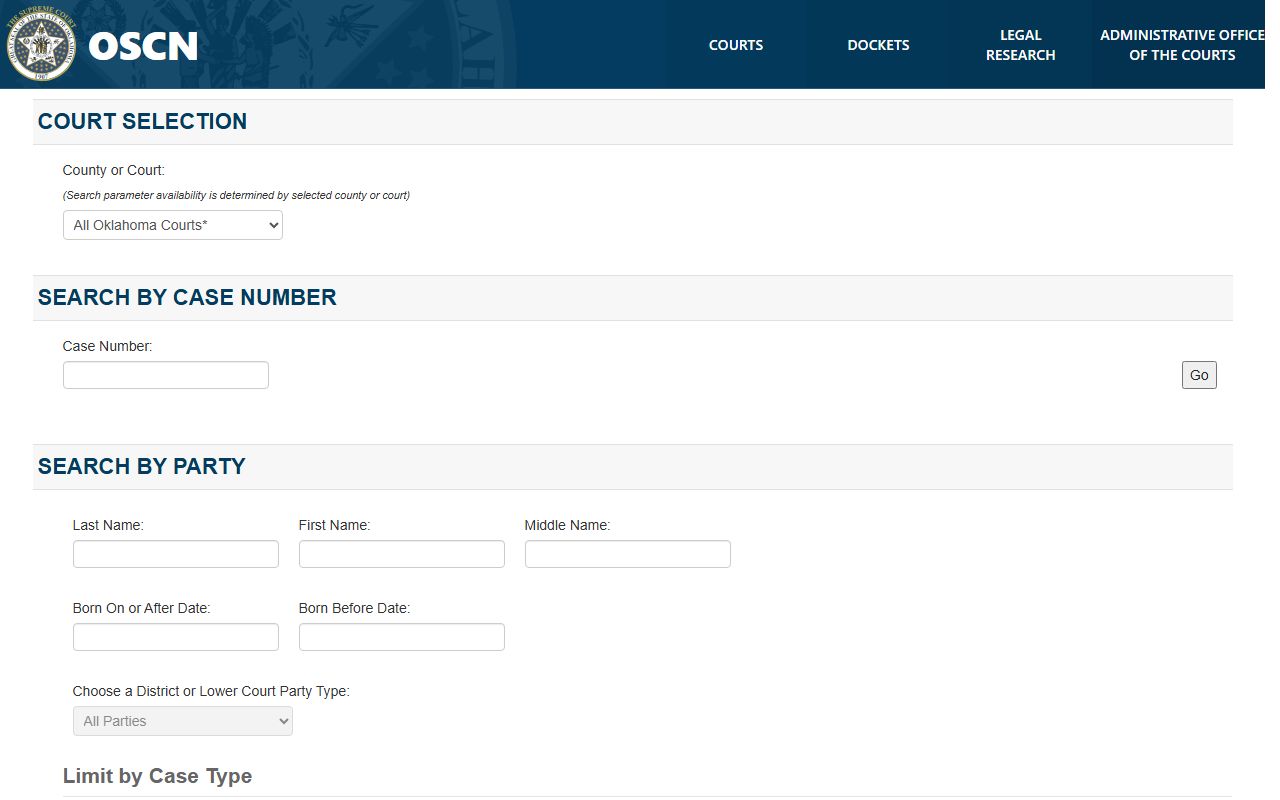
- Search OSCN by party name or case number if ODCR does not return the case or if a second public index is useful.
- Open the docket and compare the formal counts, bond entries, settings, dispositions, and orders against the arrest-charge wording on the roster.
- Contact the Major County Court Clerk for certified copies, older files, or records that are not easy to retrieve online.
OSCN's docket search includes fields for case number, party name, lower court case number, traffic citation, and filed or closed date ranges.
ODCR is also important for Major County because the ODCR status page lists Major OK and hourly updates. ODCR supports public searches across participating courts and can be used for name, partial-name, case-number, and filed-date range searches.
How Charges Get Filed After an Arrest: Complaint, Information, and Indictment
The jail roster starts with a booking event. The court record begins when a charging document is filed in district court. Oklahoma criminal procedure recognizes formal prosecution through filed pleadings such as an information, complaint, or indictment. The exact label depends on the case type and filing path, but the practical point is the same: court charges are prosecutor-filed allegations, not simply a copy of the jail intake screen.
| Document | Who Uses It | Why It Matters After Arrest |
|---|---|---|
| Complaint | Prosecutor or charging authority | Can initiate a criminal case and state the alleged offense in court language. |
| Information | District Attorney | Common Oklahoma charging document for many criminal cases filed in district court. |
| Indictment | Grand jury process | Another formal charging route for serious matters when used under Oklahoma procedure. |
| Application to revoke | Prosecutor or supervision authority | May appear when an arrest is tied to probation, suspended sentence, or deferred-sentence issues. |
Charge Status in Court Records After an Arrest
Charge status can change as the case moves through Major County District Court. A roster charge may be only the arrest or booking label. Later, the DA may file different counts, amend the wording, reduce a count, dismiss a count, or decline to proceed. Always read the docket entries, filed documents, and final disposition instead of assuming the arrest label is the final court result.
| Status | What It Means |
|---|---|
| Pending | The case or count is open and has not reached a final disposition. |
| Amended | The prosecutor or court changed the charge, count, wording, or related allegation. |
| Reduced | The filed charge was lowered to a lesser offense or different count. |
| Dismissed | The count or case ended without a conviction on that charge. |
| Nolle prosequi or declined | The prosecutor does not proceed, if that result is reflected in the docket. |
| Conviction | A formal finding or plea created a conviction. It is not the same as an arrest. |
| Deferred sentence | An Oklahoma disposition that may later be dismissed or expunged if conditions are completed. |
| Suspended sentence | A conviction with incarceration suspended subject to court-ordered conditions. |
Bond and Release After an Arrest
Major County's roster profiles inspected in the research did not show bond amount, bond type, magistrate, or court date. That means a person cannot rely on the roster alone to know whether release is possible. After booking, a judge or authorized judicial officer sets bond under Oklahoma law and local procedure. The practical path is to call the jail at (580) 227-4471 ext. 2, check ODCR or OSCN if a case has been filed, and contact the court clerk or a licensed bondsman when paperwork or a case number is needed.
The sheriff's official registered bondsmen page warns that bonds not filled out or notarized properly will not be accepted, approved, or filed by the court clerk's office, and that the defendant can be subject to re-arrest. It also says bonds must include case numbers once cases have been filed. Holds and detainers can block release even if one Major County charge has a bond.
| Bond Type | How It Works |
|---|---|
| Cash bond | Money is paid directly if the court permits release and no hold prevents it. |
| Surety bond | A licensed bondsman posts bond for a fee and handles required paperwork. |
| Personal recognizance | The court authorizes release based on a promise to appear without full cash payment. |
| No-bond hold | A court or agency status prevents release through ordinary bond payment. |
| Detainer or hold | Another county, DOC, federal, parole, probation, or immigration issue may keep the person in custody. |
Warrants That Lead to an Arrest
Major County has an official active warrant search. The warrant page accepts first name, last name, or both, with a search field labeled for first or last name. Research found that public results may show first name, last name, city, and state, but not a warrant number, charge, issuing court, bond amount, or court case number. The warrant page warns that status may not be real time and tells users not to rely only on the website to determine legal status.
If a warrant arrest leads to jail booking, the next records may split across systems. The jail roster can show custody if the person is held at Major County Jail. ODCR or OSCN can show the related district court case if one exists. The sheriff's office at 500 E Broadway #4, Fairview, OK 73737, main line (580) 227-4471, is the local fallback for warrant questions. The court clerk is the better source for filed case numbers, court settings, and certified court records.
Charges vs. Convictions
An arrest, a roster charge, and a conviction are different events. An arrest means a person was taken into custody. A charge means an allegation appears in a booking record or formal court filing. A conviction requires a plea, verdict, or formal adjudication. Major County court records after a jail arrest should be read with that sequence in mind, especially when a roster charge was later amended, dismissed, or reduced.
| Charge | Conviction | |
|---|---|---|
| Stage | Accusation or filed count | Final finding, plea, or adjudication |
| Proof | Based on arrest or prosecutor filing | Requires the legal standard for conviction |
| Record Location | Jail roster and district court docket may both mention it | District court disposition and sentence records |
| Can Change? | Yes, charges may be added, amended, reduced, or dismissed | Can be affected by appeal, set-aside, deferred outcome, or expungement order |
Sealed vs. Expunged Arrest Records
Oklahoma expungement law is in Title 22 O.S. Sections 18 and 19. Section 18 identifies categories of people who may petition for expungement, including some acquittals, dismissals, pardons, and other qualifying outcomes. Section 19 governs the process and effect of sealing or expunging law-enforcement and court records after a qualifying order. Major County does not publish a local shortcut form in the researched sheriff materials, so the records-clearing path runs through the court and the originating agency.
| Sealed | Expunged | |
|---|---|---|
| Public visibility | Hidden from ordinary public access after a valid order | Treated under the expungement order's legal effect |
| Where it applies | Can affect court and law-enforcement access depending on order terms | Can affect arrest, court, and agency records covered by the order |
| Eligibility | Depends on Oklahoma law and the case result | Depends on Title 22 eligibility and court approval |
| Local action | Contact the court or originating agency after an order is entered | Do not assume a roster, court index, or third-party copy disappears automatically |
Background Check Considerations
Casual public-record lookup is not the same as an employment, housing, insurance, credit, or tenant-screening background check. Court records after an arrest can be incomplete if a case is new, pending, sealed, corrected, or not yet synchronized across public indexes. A formal background check for an FCRA-covered purpose must follow the law that applies to consumer reports.
Important: This site is not a consumer reporting agency and may not be used for FCRA-covered decisions.
Restricted Court Records After an Arrest in Major County
Oklahoma's Open Records Act, Title 51 O.S. Sections 24A.1 and following, creates a broad public-access rule for public records unless another law makes the material confidential. Section 24A.8 covers law-enforcement records and supports access to core jail register and booking information recorded at incarceration, including name, date and cause of commitment, committing authority, criminal-offense status, prisoner description, and discharge or escape information.
That public-access rule does not mean every investigative report, juvenile matter, sealed case, protected victim record, medical record, or active investigative file is posted online. Major County Sheriff's Office records requests are handled through the Records Division, with in-person requests Monday through Friday from 9 AM to 3 PM. Victims receive one free incident report copy with acceptable in-person identity verification. Other copies may carry fees, and the sheriff page notes that some reports can be emailed while some can only be released by subpoena.
District Attorney and Court Clerk Contacts
Major County is in Oklahoma District Attorney District 26 with Woodward, Alfalfa, Dewey, and Woods counties. The official Oklahoma District Attorneys Council page identifies Christopher Boring as District Attorney. The Major County courthouse contact block for the DA is 500 E. Broadway, Fairview, Oklahoma 73737, phone (580) 227-4665, fax (580) 227-3243. The DA office reviews reports and decides what formal charges to file. It is not the custody-confirmation office for the jail roster.
The Major County Court Clerk is the route for district court records, case files, certified copies, and docket questions that cannot be solved through ODCR or OSCN. The sheriff or jail line can confirm local custody at the Major County Jail. VINE is available for custody-status notification, especially for release or transfer updates.